Entradas

Mostrando las entradas con la etiqueta Ecosistema Urbano

Corner, J. (2009). Terra fluxus

Corner, J. (2009). Terra fluxus. In I. Ábalos (Ed.), Naturaleza y artificio (1st ed., pp. 133–148). Gustavo Gili. 133           En los años inaugurales del siglo XXI el término ‘paisaje’, aparentemente anticuado, se ha vuelto a poner curiosamente de moda. La reaparición del paisaje en la inventiva cultural más amplia se debe en parte al notable aumento de la preocupación por el medio ambiente y de una conciencia ecológica global, al crecimiento del turismo y la subsiguiente necesidad de las regiones de preservar un sentido de identidad propia, y al impacto del crecimiento urbano masivo sobre las zonas rurales. Sin embargo, el paisaje también ofrece una serie de connotaciones imaginativas y metafóricas, especialmente para muchos arquitectos y urbanistas contemporáneos. Sin duda, las escuelas de arquitectura han adoptado el paisajismo en los últimos años, aun cuando hasta hace poco los arquitectos no eran capaces de (o no querían) dibuj...
Fernández, Roberto (2013). Perspectivas futuras de ecoproyectos, en Inteligencia proyectual: un manual de investigación en arquitectura

Fernández, Roberto (2013). Inteligencia proyectual: un manual de investigación en arquitectura (1a ed.). Buenos Aires: Universidad Abierta Interamericana; Teseo. 171 4. Perspectivas futuras de ecoproyectos 179 Normalmente, el tipo genérico de instrumentos entendidos como eco-proyectos y/o eco-tecnologías transformadoras de una condición contextual dada resultan usualmente coyunturales o no estructurales, puntuales y más bien tácticos y pueden encuadrarse dentro del campo de las terapéuticas orientadas a mitigar los efectos negativos de las enfermedades ambientales y estas enfermedades o manifestaciones disfuncionales son todas locales y concretas, no abstractas (…) 182 Por otra parte, también se advierte una diversificación de lo que entendemos por proyecto, una multiplicación de vías y formatos para realizar ahora en un espectro mucho más amplio, acciones que intentarán revertir problemas y aprovechar oportunidades que reivindicamos como pertenecientes a un campo nuev...

Gove (1997): A social ecology approach and applications of urban ecosystem and landscape analyses

Gove,  J. Morgan; Burch, William R. Jr. (1997): A social ecology approach and applications of urban ecosystem and landscape analyses: a case study of Baltimore, Maryland, Urban Ecosystems, 1997, 1, 259–275 259 Introduction (...) Indeed, cities may be the glory of humanity, but over the course of human evolution Homo sapiens have lived mostly as relatively isolated bands of hunter-gatherers, migratory herders, or agriculturists in scattered farming villages, farmsteads, or small trading centers. Cities have been rare and special places during the course of human history, providing habitation for only a small portion of any given contemporary global village. Linkages between plant, animal, and human ecology in America Park et al.’s (1925) landmark publication, The City, formally introduced human ecology as a new research agenda for sociology and the study of cities in America. 260-261 The Chicago School articulated and developed an approach to human ecology that...

Savard, JPL; Clergeau, P; Mennechez, G (1999): Biodiversity concepts and urban ecosystems

Savard, JPL; Clergeau, P; Mennechez, G (1999): Biodiversity concepts and urban ecosystems Abstract The association of biodiversity and urban ecosystems has usually concerned the impact of  urbanization on biodiversity. However, biodiversity concepts can easily be applied to the urban ecosystem itself. As more and more people live in cities, restoration, preservation and enhancement of biodiversity in urban areas become important. Concepts related to biodiversity management such as scale, hierarchy, species identity, species values, fragmentation, global approaches can be used to manage urban biodiversity. Application of these concepts in such arti®cial ecosystems may yield important insights for the management of natural ecosystems. Birds are highly visible and quite sensitive to changes in habitat structure and composition. Bird species richness in urban ecosystems is in¯uenced both by local and landscape characteristics and a multiscale approach is essential to its proper mana...

LEFF, Enrique (2007): La complejidad ambiental

LEFF, Enrique (2007): La complejidad ambiental, Polis Revista Latinoamericana, 16/2007 1.          Descripción tesis del autor La crisis ambiental es esencialmente una forma de conocimiento, debemos abrazar un pensamiento ambiental como una aproximación a un diálogo de saberes como nueva forma de conocimiento 2.          Abordaje La crisis ambiental representa una crisis del conocimiento. El autor plantea la necesidad de nuevas aproximaciones epistémicas, aceptando una crisis de la racionalidad científica, hacia un diálogo de saberes, que acepte una ética de la otredad, una política de la diferencia, para lograr un futuro sustentable 3.          Andamiaje conceptual o metodológico Complejidad ambiental como marco epistémico 4.          Argumentación Crisis ambiental=nueva era histórica/ La muerte entrópica del p...

MCHARG, Ian (2000): Proyectar con la naturaleza

196 Perspectivas ¿Implica el proceso de creación el uso de energía y de materia en niveles de orden ascendentes? La materia no se destruye, pero el orden puede quedar reducido; ¿es entonces mejor denominar a la destrucción reducción-anticreación? ¿Es exacto y conveniente considerar que la Tierra es un superorganismo único, que los océanos y la atmósfera son orgánicos? ¿Muestran los procesos de creación y de reducción características que los definen y pueden quedar estas incluidas en la negentropía y la entropía? ¿Son la adaptación y el proceso de adaptación medidas de creación en los ecosistemas? Si forma y proceso son simplemente aspectos del fenómeno único del ser, ¿existe una noción de forma intrínseca? Y, por último, ¿son la salud y la enfermedad criterios sintéticos para la creación y la reducción, para la capacidad de adaptación y para la imposibilidad de lograrla? Si es así, tenemos un modelo. Más aún, tenemos criterios. El primero es la negentropía, el aumneot en los niveles ...

Berntsen, Duncan (2013): Pastoral Manoeuvres: Ecologies of City, Nature & Practice

Berntsen, Duncan (2013): Pastoral Manoeuvres: Ecologies of City, Nature & Practice; Architectural Design Footnote (p. 134): The Etzkowitz and Leydesdorff triple-helix approach to university–industry–government relations for innovation1 was here extended, proposing culture and society as a fourth helix and bringing community to the heart of innovation processes. (135) The ‘pastoral’ is in fact an intangible rather than physical construct, and this intangible element has increasing value much needed by our cities and economies. Its heart lies in notions of simplicity, Charm and serenity; Arcadian contentment lying deep in the psyche of our populations (...) but can these intangibles be defined and articulated today to commodify public spaces, making them more accessible and valuable, and hence available contributions to the value chain? (...) By defining the obscure character of the pastoral as intangibles of the Arcadian idyll, we can begin to communicate it, value it and ex...
Imagen
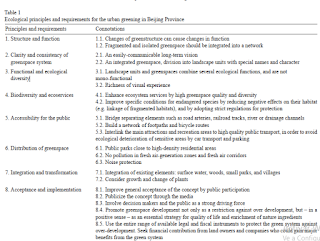
LI, Feng; WANG, Rusong; PAULUSSEN, Juerguen, LIU, Xusheng (2004): Comprehensive concept planning of urban greening based on ecological principles: a case study in Beijing, China, Landscape and urban planning 326 Urbanization increases the distance between people and natural space. Urban greenspaces are an important component of the complex urban ecosystem. Parks, forests and farmlands are three main types of urban greenspace, which have significant ecological, social and economic functions (Bradley, 1995; Shafer, 1999; Tyrv¨ainen, 2001; L¨utz and Bastian, 2002) (...) Greenspace has significant ecosystem services, which are defined as “the benefits human population derives, directly or indirectly, from ecosystem functions” (Costanza et al., 1997). It can sequester carbon dioxide emissions and produce oxygen (Jo, 2002), purify air and water, regulate micro-climate, reduce noise (Bolund and Hunhammar 1999), protect soil and water (Pauleit and Duhme, 2000; Jim, 2001), maintain biodiv...